

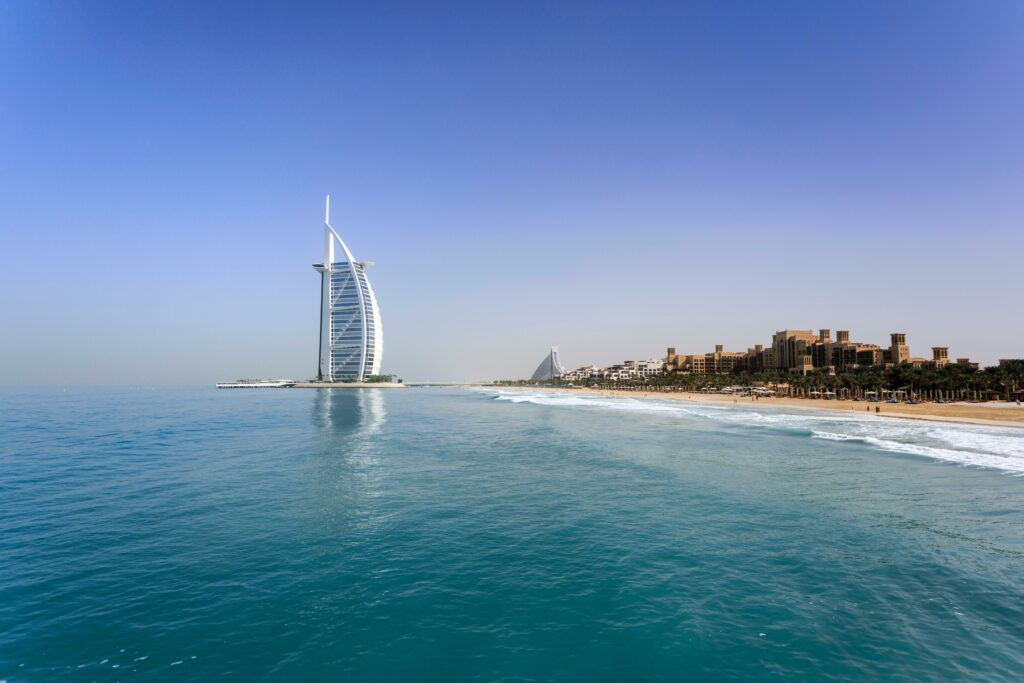

The United Arab Emirates (UAE) is a federation of seven emirates located on the southeastern coast of the Arabian Peninsula, in the Persian Gulf. Since its formation in 1971, the UAE has experienced rapid and spectacular development, becoming one of the most advanced and diversified economies in the Middle East. This article explores the UAE’s evolution, its current situation, and the impact of its development model.
Economic and Social Development of the United Arab Emirates
The United Arab Emirates has long been associated with oil resources, but the country has successfully diversified its economy over the past few decades. While oil reserves remain a major source of revenue, the UAE has developed sectors such as finance, trade, tourism, construction, and technology.
Economic Growth: The development of modern infrastructure and free zones, such as those in Dubai, has enabled the UAE to position itself as a regional and international hub for business and trade. The country has invested in ambitious projects, such as the Burj Khalifa, the world’s tallest skyscraper, and Palm Jumeirah, a famous artificial island.
Economic Diversification: Through the “Vision 2021” initiative and other long-term development plans, the UAE has focused on diversification to reduce its dependence on oil. Significant investments have been made in renewable energy, finance, technology, and transportation. Dubai, in particular, has become a global financial center and a leading tourist destination.
Energy Sector: While oil continues to play a central role, the UAE has also invested in renewable energy, with flagship projects such as the Mohammed bin Rashid Al Maktoum Solar Power Plant in Dubai and the Barakah Nuclear Power Plant in Abu Dhabi, which marks the country’s entry into civilian nuclear power.
Education and Healthcare: Modernization and Access to Quality Services
The Emirates have also invested heavily in education and healthcare to support the growth of a modern and well-educated society.
Education: The country is focusing on improving its education systems, with internationally recognized schools and prestigious universities, including Paris-Sorbonne University in Abu Dhabi and New York University Abu Dhabi. The government also encourages young people to pursue studies in technical and scientific fields to support the transition to a knowledge-based economy.
Healthcare: The UAE’s healthcare system has been modernized with the construction of high-quality medical centers. Healthcare is widely accessible, including for expatriates, and the country is attracting a growing number of international patients thanks to the quality of its treatments, particularly in cosmetic surgery and specialized therapies.
Social and Geopolitical Challenges
Despite its economic successes, the UAE faces certain social and geopolitical challenges:
Workers’ Rights and Inequality: Migrant workers constitute a significant proportion of the workforce, particularly in the construction and service sectors. The working conditions of some of these workers, primarily from South Asia, have drawn international criticism. While the authorities have taken steps to improve the situation, challenges remain regarding labor rights and social inequality.
Human Rights and Freedoms: The UAE government is an authoritarian regime with restrictions on freedom of expression and the press. Criticism of the government or its policies can be suppressed, and political rights are limited. However, the country has made progress in some areas, such as combating domestic violence and promoting gender equality in certain professions.
Geopolitics: Due to its strategic location, the UAE is a key player in Gulf geopolitical affairs. It played a significant role in the coalition against terrorism and established diplomatic relations with Israel in 2020, marking a turning point in regional politics.
The Human Development Index (HDI) of the United Arab Emirates
The UAE’s HDI is among the highest in the region, placing the country in the “very high levels of human development” category. This index reflects massive investments in social infrastructure, education, health, and quality of life. Life expectancy is high, literacy is nearly universal, and access to healthcare is top-notch.
Conclusion
The United Arab Emirates has successfully transformed itself from a small, oil-rich state into a modern and diverse nation with infrastructure
